Hydrostatic vs. Pneumatic Pressure Testing: Safety Risks and Key Differences
Choosing between hydrostatic and pneumatic pressure testing is one of the most important safety decisions in a pipeline project. Although both methods are used to verify system integrity, they carry very different risks if a pipe, weld, or fitting fails under pressure.
Hydrostatic testing uses water, while pneumatic testing relies on compressed air or gas, such as nitrogen. The choice often comes down to practical concerns, including water availability, disposal requirements, drying time, and project schedules. However, these factors shouldn’t outweigh the potential consequences of a failure during testing.
The key difference is the amount of energy stored inside the pressurized system. Compressed gas can release significantly more energy during a rupture than water at the same pressure, creating greater blast and projectile hazards. Experienced pressure testing providers evaluate these risks alongside applicable codes and project requirements before recommending a testing method.
The Problem Is Stored Energy, Not Pressure
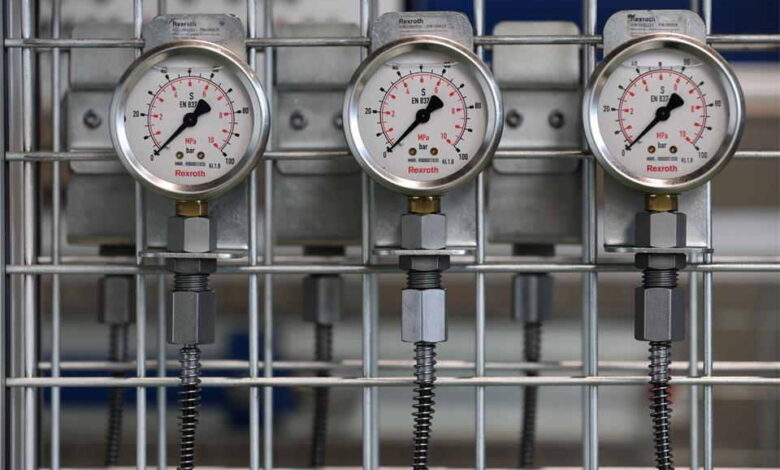
A pipeline under test looks the same whether it’s full of water or full of nitrogen. The gauges read the same number. The pressure acting on the welds is the same. What differs is how much energy the system is holding, and how violently it releases that energy if something gives way.
Water is nearly incompressible. When a hydrostatic test fails, the stored energy dissipates almost instantly as the small compressed volume relaxes, and test pressure drops to zero before the rupture can do much more than crack and leak.
Compressed gas behaves the opposite way. At typical test pressures, a gas-filled line can hold roughly two hundred times more stored energy than the same line filled with water. That energy has to go somewhere when the pipe opens, and it tends to go outward as a blast wave and as projectiles. This single fact drives every other decision on the project, and it’s why the codes don’t treat the two methods as equivalent.
Why Picking Air Just to Avoid Water Backfires
When water is inconvenient, the intuitive answer is to switch to air or nitrogen. No fill, no disposal, no drying, no freeze risk in cold weather. On paper, the project moves faster and cheaper. In practice, the gain evaporates once the full control package shows up.
Pneumatic testing carries a different code treatment for a reason. ASME B31.3, the piping code most process projects live under, caps pneumatic test pressure much closer to design pressure than its hydrostatic counterpart, and layers in exclusion zones, slower pressurization steps, and hold points at successive pressure plateaus.
On transmission pipelines operating above a defined stress threshold, the federal spike test rule simply mandates water as the medium. The operator doesn’t get to choose.
Even where pneumatic is allowed, the hidden costs show up quickly:
- Exclusion zones. A pneumatic test clears people and non-essential equipment out of a danger radius for the duration. On a congested site, that stops other crews from working.
- Stepped pressurization. Gas tests ramp up in stages with holds at each level to inspect for leaks before continuing. The test window stretches from hours into a shift or more.
- Brittle-fracture screening. Carbon steel at low temperatures behaves differently under stored gas than under water, and the metallurgy has to be cleared before the test is approved.
- Asphyxiation controls. Nitrogen displaces oxygen. Any confined-space work near the test area needs monitoring, signage, and a rescue plan that a water fill wouldn’t require.
Add it up and the “faster, cheaper” test usually isn’t.
Match the Medium to the System, Not the Schedule
The better way to make the call is to start from the system and the service, and let the medium follow. A few questions settle most projects:
- What does the governing code require? If the code names water, the discussion is over. Where it allows a choice, it almost always frames pneumatic as the exception that requires written justification.
- Can the system tolerate water at all? Lines carrying moisture-sensitive service, catalyst beds, instrument tubing, or cryogenic duty may be ruined by residual water that can’t be fully dried out. These are the legitimate pneumatic cases.
- What’s the consequence of a rupture at test pressure? If the line runs through or near occupied space, water keeps blast and projectile risk to something manageable, while gas leaves the full stored energy to go outward.
- Is there a hybrid path? A hydrostatic strength test followed by a pneumatic tightness test at lower pressure often gives you the structural proof water provides and the leak sensitivity gas provides, without exposing anyone to a high-pressure gas rupture.
Get the medium decision right at the front and the rest of the test plan tends to write itself. Get it wrong and no amount of procedure around it will fully compensate for the physics.